
“The only way to stop feeling like an imposter is to stop thinking like an imposter.” — Dr. Valerie Young
From awareness to action
In our last post, we named imposter syndrome for what it is: the silent thief of success. It doesn’t stop you from achieving, it stops you from owning what you’ve achieved.
You hit the milestone, but instead of celebrating, you question it.
You succeed, but you attribute it to luck.
Here’s the truth:
Imposter syndrome is not a lack of ability, it’s a pattern of thinking.
It’s the gap between:
- what you’ve done, and
- what you believe about yourself
And the good news?
Patterns can be rewritten.
Why this matters
If you don’t challenge these patterns, they quietly shape how you work, lead, and show up:
- You overwork to “prove” yourself
- You hesitate to go for opportunities
- You avoid visibility
- You struggle to enjoy your progress
So instead of growing with confidence, you grow with pressure.
Let’s change that.
The 5 types of imposter syndrome (and how to shift them)
You may not relate to all of these, but you’ll likely see yourself in one or two.
The goal isn’t to label yourself. It’s to identify your pattern so you can interrupt it.
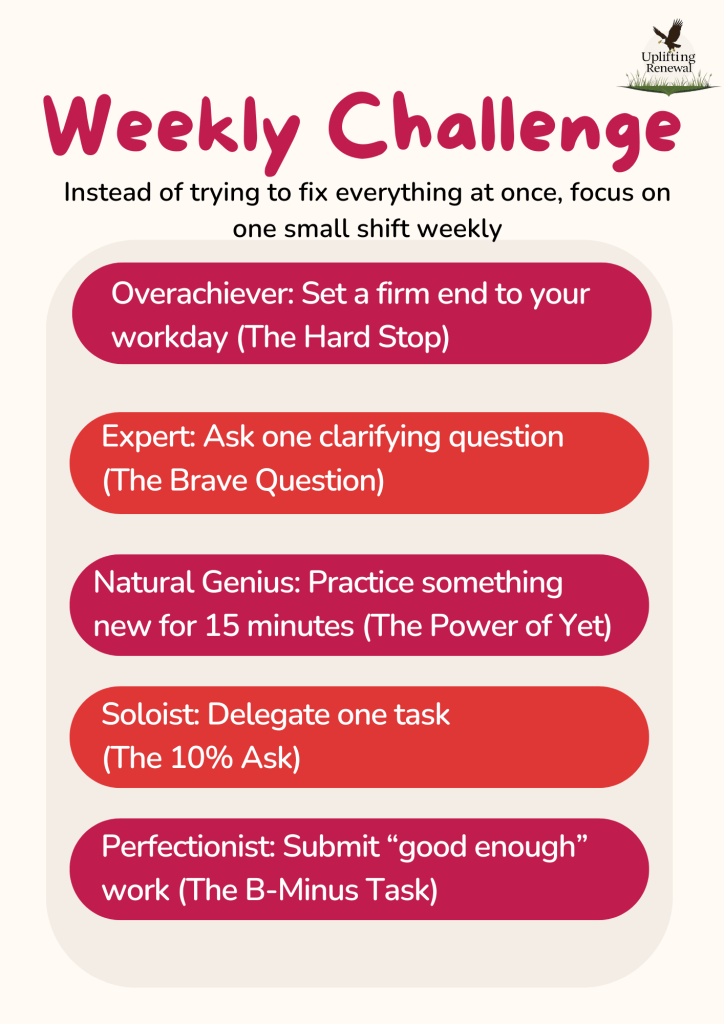
1. The overachiever (The superhuman)
What it sounds like:
“I have to excel in everything to prove I belong.”
The trap:
You run at 110% in every role: career, family, friendships because slowing down feels like failure.
But constant output ≠ sustainable success.
The shift:
Redefine success through values, not volume.
Practical move:
- Choose 3 core priorities per week (not 10)
- Ask: “What actually matters this week?”
- Build space for rest, not just results
You don’t prove your worth by doing more, you protect it by doing what matters.
2. The expert
What it sounds like:
“I need to know everything before I start.”
The trap:
You delay action, avoid speaking up, or skip opportunities because you don’t feel “ready enough.”
The shift:
Trade certainty for curiosity.
Practical move:
- Ask one question in your next meeting
- Apply for roles where you meet ~70–80% of the criteria
- Replace “I should know this” with “I can learn this”
Growth doesn’t start with knowing, it starts with engaging.
3. The natural genius
What it sounds like:
“If this doesn’t come easily, I must not be good at it.”
The trap:
You avoid challenges that make you feel like a beginner.
You equate struggle with incompetence.
The shift:
Redefine intelligence as persistence.
Practical move:
- Spend 15 minutes daily on something you’re not good at yet
- Track effort, not just outcomes
- Use the phrase: “I don’t know this… yet.”
Mastery is built, not born.
4. The soloist
What it sounds like:
“I should be able to do this on my own.”
The trap:
You avoid asking for help, over-carry responsibility, and head straight toward burnout.
The shift:
See collaboration as strength, not weakness.
Practical move:
- Delegate one small task this week
- Ask for input before finalising a decision
- Replace “I have to do this alone” with “Who can help me do this better?”
Your impact grows when you stop working in isolation.
5. The perfectionist
What it sounds like:
“If it’s not perfect, it’s not good enough.”
The trap:
You overanalyse, delay progress, and focus on the 5% that went wrong instead of the 95% that worked.
The shift:
Chase impact, not perfection.
Practical move:
- Use the 80/20 rule: focus on what drives results
- Submit or share work at 80% completion
- Celebrate finished work, not flawless work
Perfection delays progress. Action creates momentum.
Bringing it all together
Every imposter pattern has one thing in common:
It keeps you focused on what you lack instead of what you bring.
Rewriting the script doesn’t mean eliminating doubt overnight.
It means choosing a different response when doubt shows up.
“Abilities aren’t fixed; they are developed through effort.” — Carol Dweck
You don’t need a new personality.
You need a new pattern.
Imposter syndrome may speak, but it doesn’t get the final word.
You are not behind.
You are not underqualified.
You are in progress and that’s exactly where growth happens.
Next: We’ll explore how to build daily habits that reinforce confidence and silence the “fraud” narrative for good.






 Uplifting Renewal
Leave a comment