
“Inaction breeds doubt and fear. Action breeds confidence and courage.” – Dale Carnegie
Confidence is one of the most misunderstood qualities in personal and professional growth.
Many people think it’s something you either have or don’t have.
In reality, confidence is something you build through action, evidence, and repetition.
Confidence vs. arrogance: know the difference
They can look similar but they come from completely different places.
- Arrogance is loud. It tries to prove worth by overpowering others.
- Confidence is calm. It doesn’t need validation, it’s grounded in truth.
In simple terms:
- Arrogance says: “I need you to believe I’m good.”
- Confidence says: “I know I’ll be okay either way.”
One is rooted in insecurity. The other is built on evidence.
What confidence actually is
Confidence is not a personality trait. It’s not about being extroverted or fearless.
Confidence = Trust in your ability to handle what comes next.
That trust is built from:
- Experience
- Small wins
- Keeping promises to yourself
You don’t become confident by thinking differently. You become confident by doing differently, consistently.
“Confidence is a habit that can be developed by acting as if you already had the confidence you desire to have.” – Brian Tracy
The shift that changes everything
Stop chasing feelings, rather start collecting proof. Most people get the sequence wrong:
“I’ll act when I feel confident.”
But confidence doesn’t come first. Action does.
The right sequence is: Act → Build evidence → Feel confident
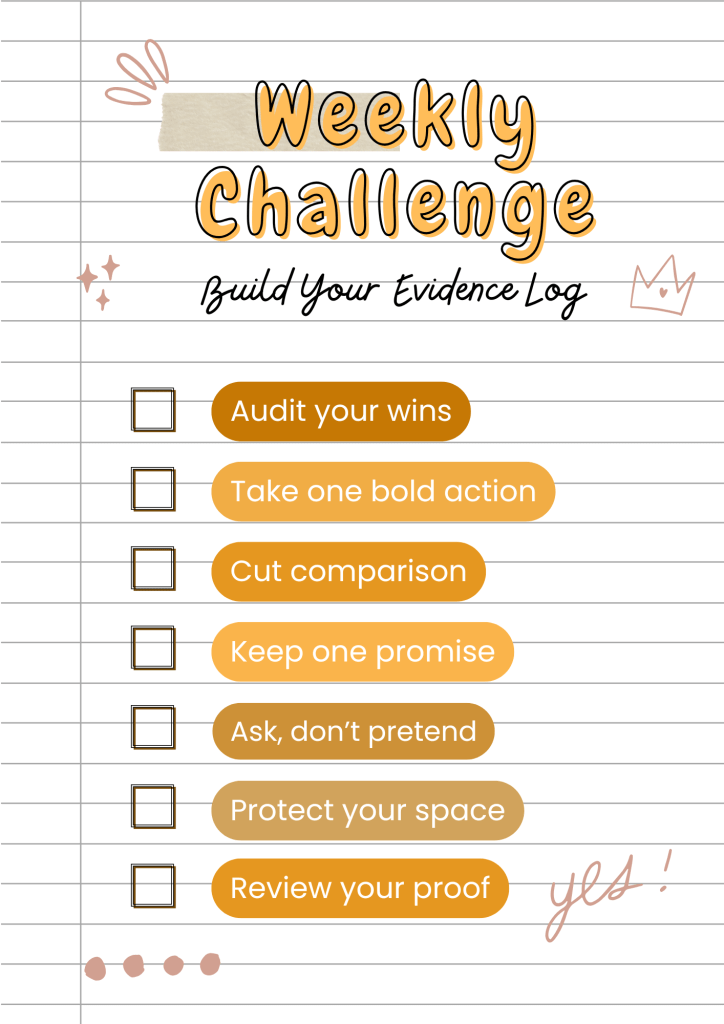
The practical tool: Your “evidence log”
Instead of “faking it,” build cognitive confidence. This is confidence based on facts.
Think of it like building a case for yourself.
Start here:
Create a simple “Evidence Log” (notes app or notebook)
Each day, record:
- One thing you did well
- One problem you solved
- One positive feedback or result
Over time, this becomes your personal proof bank.
This becomes especially powerful when you’re preparing for a promotion or stepping into an interview.
One of the biggest challenges in those moments isn’t a lack of experience it’s recall. Over time, it’s easy to forget the projects you’ve led, the value you’ve added, or the challenges you’ve successfully navigated.
That’s why building a personal record matters.
When you consistently document your wins, successful projects, key contributions, problems you solved, and moments where you stepped up, you create a living archive of your impact. Over time, this becomes your “career brag sheet”: a clear, confident record of your growth, capability, and results.
Instead of scrambling for examples or downplaying your achievements, you’ll be able to speak with clarity, evidence, and confidence because you’re not guessing, you’re referring to proof.
So when doubt shows up, you don’t rely on feelings, you rely on facts.
Why this works
Your brain has a bias: It remembers one mistake more than ten wins.
Without intentional tracking:
- You forget your progress
- You exaggerate your failures
- You question your ability
The Evidence Log corrects that imbalance.
The 3 biggest confidence killers (and how to handle them)
1. The negativity bias: The problem here is that one mistake overshadows everything. To fix this, you’d need to log your wins frequently, even the small ones.
2. The comparison trap: This is when you compare your progress to someone else’s peak. Don’t get caught in this trap, rather measure against your past self.
Ask: Am I better than I was 6 months ago?
3. The “fake it” pressure: The problem here is when you’re performing confidence instead of building it. Confidence isn’t pretending, it’s remembering. So replace performance with proof.
The rule you need to remember
Act first. Feel later.
You don’t need confidence to start, you need movement. You didn’t learn to walk because you felt confident. You learned because you kept trying.
Confidence is the result of showing up repeatedly.
Confidence grows every time you:
- Keep a promise to yourself
- Finish what you started
- Take action despite doubt
These moments seem small but they stack.
That’s how self-trust is built.
A scriptural perspective: Confidence with foundation
From a biblical lens, confidence isn’t rooted in self, it’s rooted in identity and trust in God.
- “God has not given us a spirit of fear, but of power…” – 2 Timothy 1:7
- “Now faith is confidence in what we hope for…” – Hebrews 11:1
Even David didn’t face Goliath with blind confidence, he referenced his past victories (his own “evidence log”).
The pattern is consistent:
- Action comes before feeling (Joshua 1:9)
- Growth is a process, not perfection (Philippians 1:6)
You don’t have to feel ready to move. You just have to trust who is with you and what you’ve already overcome.
“Confidence is not ‘they will like me.’ It’s ‘I will be okay if they don’t.” – Christina Grimmie
Confidence isn’t something you wait for, it’s something you build.
- Through action
- Through consistency
- Through evidence
You don’t need to be perfect. What you need is to be in motion.
Stop shrinking.
Stop waiting.
Start showing up.







 Uplifting Renewal
Leave a comment