
“I have written eleven books, but each time I think, ‘Uh oh… they’re going to find out now.’” — Maya Angelou
The quiet struggle many don’t talk about
There’s a voice many high achievers know well, but rarely admit out loud.
It whispers:
- “You just got lucky.”
- “You don’t really belong here.”
- “Soon, they’ll find you out.”
This is imposter syndrome and despite how isolating it feels, it’s incredibly common.
At its core, imposter syndrome is the internal belief that you are not as competent as others perceive you to be.
Even with clear evidence of your success; promotions, results, qualifications, you feel like a fraud. Your achievements are dismissed as luck, timing, or external factors rather than your capability.
It doesn’t stop your success.
It steals your ability to enjoy it.
Why it shows up (especially in high achievers)
Imposter syndrome thrives where standards are high.
For many, especially women navigating leadership, visibility, or underrepresentation, it’s amplified by:
- Perfectionism: The belief that anything less than flawless equals failure
- External pressure: Feeling you must constantly prove your worth
- Comparison: Measuring your behind-the-scenes against someone else’s highlight reel
- New environments: Being “the only one in the room” and feeling exposed
If you’ve ever felt like you had to work twice as hard just to belong, you’re not alone.
Meet “Mary” success in public, doubt in private
Mary is a Senior Marketing Manager. She’s respected, delivers results, and leads a strong team.
But internally, her narrative sounds like this:
- “That campaign only worked because of timing.”
- “They just needed someone to fill the role.”
- “If I slow down, they’ll realise I’m not actually that good.”
So what happens?
- She overworks to prove her worth
- She avoids celebrating wins
- She feels constant low-level anxiety
- She hesitates to ask for help, fearing exposure
Mary isn’t underperforming. She’s overcompensating for a belief that isn’t true.
“The beauty of imposter syndrome is you vacillate between egomania and ‘I’m a fraud!’” — Tina Fey
The real cost of imposter syndrome
Left unchecked, imposter syndrome creates a quiet but powerful cycle:
- Burnout from overworking to “keep up the illusion”
- Missed opportunities because you don’t feel ready
- Emotional exhaustion from constant self-doubt
- Disconnection from joy, even in success
You keep achieving but never arriving.
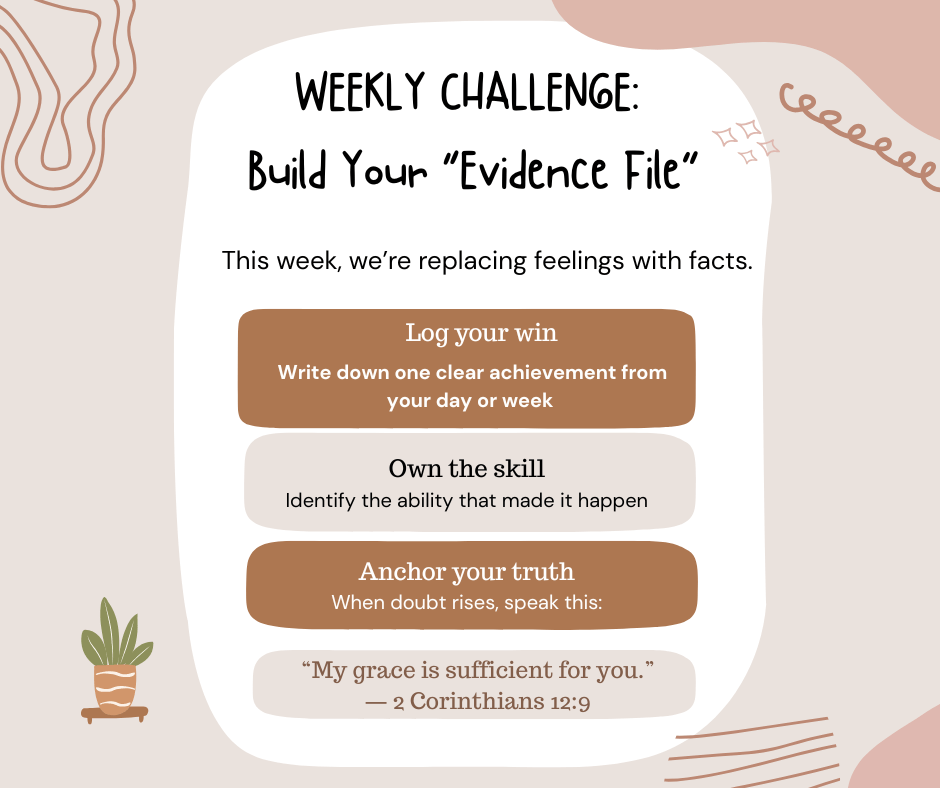
The shift: From feelings to facts
Here’s the truth:
Imposter syndrome is not a reflection of your ability, it’s a distortion of your perception.
It’s the gap between:
- How you see yourself
vs. - What your results actually prove
Recognising this is the first step to breaking the cycle
A faith-based perspective: Identity over insecurity
From a scriptural lens, imposter syndrome is more than a mindset, it’s a tension between fear and identity.
When we focus only on our limitations, we will always feel inadequate for big assignments. But Scripture redirects our focus:
“My grace is sufficient for you, for my power is made perfect in weakness.” — 2 Corinthians 12:9
The message is simple but powerful: You were never meant to rely on your strength alone.
Many biblical leaders felt deeply unqualified:
- Moses: “Who am I to go?” (Exodus 3:11)
- Gideon: “I am the least…” (Judges 6:15)
- Jeremiah: “I am too young.” (Jeremiah 1:6)
- Isaiah: “I am unclean.” (Isaiah 6:5)
Yet each one was called, equipped, and positioned. Not because they felt ready, but because they were chosen.
The shift isn’t proving your worth. It’s trusting the One who called you worthy.
What to take with you
- Feeling like an imposter doesn’t mean you are one
- Your success is not accidental, it’s evidence
- Growth often feels like discomfort before it feels like confidence
- You don’t need to eliminate doubt to move forward, you just need to stop believing it blindly
“If you’re not feeling a little bit of imposter syndrome, you’re probably not pushing yourself hard enough.” — Sheryl Sandberg
You are not a fraud standing in opportunity.
You are a capable person growing into it.
You are not “getting away with it.”
You are walking in what you’ve earned, learned, and been prepared for.
And this is just the beginning.
Next in the series: Understanding the different types of imposter syndrome and how to break each one.







 Uplifting Renewal
Leave a comment