

“The single biggest problem in communication is the illusion that it has taken place.” — George Bernard Shaw
We live in a time of constant connection. Messages are sent instantly. Opinions spread rapidly. Everyone is speaking.
Yet despite all this communication, many people still feel misunderstood, unheard, disconnected, or misrepresented.
Why?
Because communication is not just about sending words.
It is about creating understanding.
A message is only successful when it is clearly received, correctly understood, and responsibly interpreted.
Whether you are:
- leading a team,
- speaking to your family,
- navigating conflict,
- building relationships,
- managing a community,
- or influencing people online,
communication remains one of the most powerful skills you will ever develop.
The way you communicate at home often reflects the way you lead in public.
The essence of communication
At its core, communication is the bridge between minds, emotions, and intentions.
It is not simply what you say, but also how you say it, when you say it, why you say it, and how it is received.
Many people focus only on delivering information. But effective communication is about building clarity, trust, empathy, and connection.
Communication is both a science, and an art.
The science:
- structure,
- clarity,
- timing,
- medium,
- and information flow.
The art:
- empathy,
- emotional awareness,
- listening,
- tone,
- discernment,
- and wisdom.
You can say the right words with the wrong tone and still create damage.
Communication shapes every area of life
Communication does not happen in isolation. It affects every major area of our lives.
Professional communication – clarity builds trust
In the workplace, communication is the foundation of leadership, productivity, and culture.
Confusion creates delays, assumptions create mistakes.
Silence creates uncertainty.
Clarity is kindness.
Good communicators do not simply assign tasks, they provide context.
Instead of only telling people what to do, explain:
- Why it matters
- What success looks like
- What the priorities are
- What outcome is expected
Use the S.T.A.R. method when giving updates:
- Situation: What happened?
- Task: What needed to be done?
- Action: What was done?
- Result: What happened because of it?
This keeps communication structured and concise.
Family communication – connection over efficiency
At home, communication is less about productivity and more about presence.
Many relationships suffer not because love disappeared, but because communication weakened.
People often remember:
- how you spoke to them,
- how safe they felt around you,
- and whether they felt heard.
Create moments without distraction:
- Put the phone down
- Make eye contact
- Listen fully
- Avoid rushing conversations
Sometimes the most powerful communication is simply being fully present.
Personal communication — learn to listen
One of the greatest communication mistakes is listening only to reply.
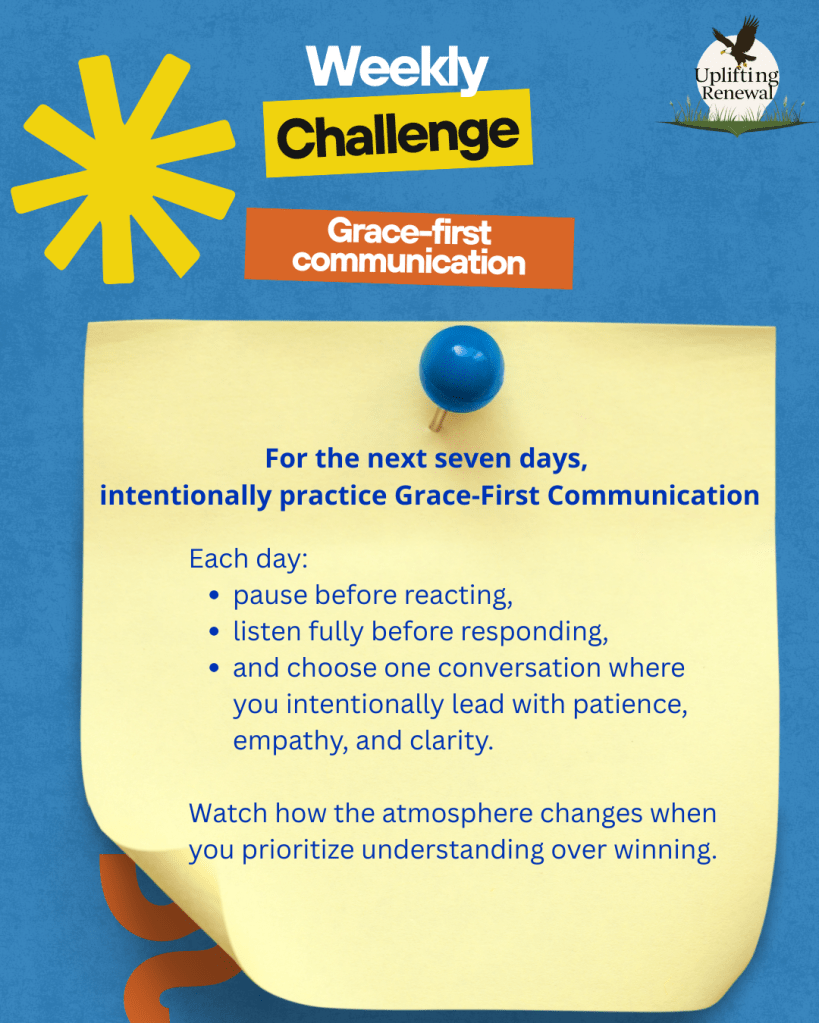
True listening seeks understanding.
Active listening means:
- not interrupting,
- not preparing your comeback,
- and not assuming you already know what the person means.
Before responding, ask:
“Am I trying to understand, or am I trying to win?”
That question alone can transform conversations.
Community & society – speak responsibly
In the digital age, words spread quickly. So does misinformation.
One careless statement can:
- damage reputations,
- create division,
- escalate conflict,
- or destroy trust.
Communication carries responsibility.
Before sharing information online, ask:
- Is it true?
- Is it verified?
- Is it helpful?
- Is it necessary?
- Is it kind?
Not every opinion needs immediate expression.
The communication blueprint
Effective communication is a skill that must be practiced intentionally.
Here are four foundational principles:
- Active listening: Listen to understand, not merely to respond. People open up when they feel genuinely heard.
- Clarity & brevity: Do not bury your message in unnecessary words. If something can be communicated clearly in ten words, avoid using fifty. Clear communication reduces confusion and conflict.
- Non-verbal communication: Your body language, tone, facial expressions, and posture communicate just as loudly as your words. Sometimes people respond more to your tone than your actual sentence. Pay attention to eye contact, posture, tone, pacing, and facial expression.
- The feedback loop: Communication is incomplete without confirmation. Never assume your message was understood exactly as intended. Simple phrases that help:
- “Does that make sense?”
- “How did you interpret that?”
- “Can you summarize what we agreed on?” Without feedback, communication becomes broadcasting.
Why communication breaks down
We often imagine communication as a straight line:
I said it → They understood it.
But communication is actually a loop and there are many places where it can fail.
- The sender: Everything begins with your intention. If you are unclear internally, your message will likely be unclear externally.
- The encoding: This is how you package your thoughts into words, tone, or visuals. A common problem is using jargon, assumptions, emotional reactions, or vague language.
- The channel: The medium matters. Not every conversation belongs in text messages, emails, or public platforms. Match the seriousness of the conversation to the communication method. Some conversations deserve a voice, face-to-face interaction, or privacy.
- The receiver: People interpret messages through emotions, past experiences, stress, personality, and assumptions. Two people can hear the same sentence and interpret it completely differently.
- Feedback: This closes the loop. If there is no confirmation or understanding, the message remains incomplete.
How to repair miscommunication
No one communicates perfectly all the time. We will all:
- misspeak,
- misunderstand,
- overreact,
- or communicate poorly at some point.
The goal is not perfection, but to repair.
4 practical steps to repair miscommunication
- Address issues early: Small misunderstandings become major conflicts when ignored.
- Understand “intent vs. impact”: Your intention may have been good, but the impact may still have caused hurt. Mature communication acknowledges both.
- Clarify without defensiveness: Avoid turning every misunderstanding into a courtroom defence. Focus on restoring understanding, not protecting pride.
- Ask better questions: Instead of, “why are you upset?”
Try, help me understand what you experienced.” That shifts the conversation from confrontation to connection.
“A lie can travel halfway around the world while the truth is putting on its shoes.” — Charles Spurgeon
A scriptural perspective on communication
From a biblical perspective, communication is not just about speech, it is about stewardship.
Words have the power to heal, build, guide, encourage,
or destroy.
Scripture reminds us:
“Death and life are in the power of the tongue.” — Proverbs 18:21
Communication begins in the heart:
“Out of the abundance of the heart the mouth speaks.” — Luke 6:45
The Bible repeatedly emphasizes:
- restraint,
- wisdom,
- truth,
- grace,
- and listening.
Biblical principles that still solve modern problems:
- Be quick to listen, slow to speak (James 1:19): Listening improves both relationships and decision-making.
- Speak truth in love (Ephesians 4:15): Truth without love becomes cruelty and love without truth becomes dishonesty. Healthy communication requires both.
- Use words that build (Ephesians 4:29): Communication should strengthen people, not constantly tear them down.
- Gentle answers reduce conflict (Proverbs 15:1): Tone can either escalate tension or calm it. A softer response often creates space for resolution.
“Words are, of course, the most powerful drug used by mankind.” — Rudyard Kipling
Communication is more than speaking well. It is the ability to build trust, create understanding, resolve conflict, strengthen relationships and reflect wisdom.
Your words shape environments. They can create peace, fuel division, build confidence or destroy trust.
Choose them carefully.
In a world filled with noise, intentional communication becomes a form of leadership.
Do not just aim to be heard. Aim to bring clarity, wisdom, and understanding wherever you speak.







 Uplifting Renewal
Leave a comment