
“Alone we can do so little; together we can do so much.” — Helen Keller
We are living through a quiet global crisis.
Across workplaces, homes, classrooms, communities, and even places of worship, many people are emotionally exhausted. People are functioning on the outside while silently carrying anxiety, burnout, emotional fatigue, and mental overwhelm on the inside.
The pressure to “keep going” has become so normal that many no longer recognise how drained they truly are.
When mental and emotional well-being begins to fracture, it affects everything:
- our productivity,
- our relationships,
- our physical health,
- our ability to think clearly,
- and even our sense of hope.
But burnout does not have to become our identity.
Healing begins when we stop treating exhaustion as weakness and start recognising it as a signal that something needs attention.
Mental and emotional well-being is not a luxury. It is a foundation for a healthy life.
Why are so many people emotionally exhausted?
Mental distress rarely comes from one single event. More often, it is the result of prolonged pressure, emotional overload, and environments that constantly demand more than people can sustainably give.
In the workplace
Many people are carrying:
- unrealistic workloads,
- constant digital connectivity,
- poor leadership,
- job insecurity,
- and pressure to always perform.
The inability to “switch off” has blurred the line between work and rest.
In families and relationships
Emotional exhaustion can come from:
- financial pressure,
- emotional neglect,
- caregiving responsibilities,
- unresolved conflict,
- and the invisible mental load of managing daily life.
Sometimes people are physically present but emotionally overwhelmed.
In schools and learning environments
Students are increasingly battling:
- academic pressure,
- fear of failure,
- uncertainty about the future,
- social comparison,
- and isolation created by digital culture.
Many young people are highly connected online but deeply disconnected emotionally.
In society and communities
Modern culture often promotes hyper-independence:
- “Handle it yourself.”
- “Don’t burden others.”
- “Keep pushing.”
As community spaces weaken, people carry heavy emotional burdens alone.
Shifting the narrative: empower, ignite, restore
Improving mental and emotional well-being requires more than reacting to crises after they happen.
We must create healthier environments before people break down.
True well-being is both personal and collective.
1. Empowering minds (prevention and emotional skills)
Empowerment means giving people practical tools to protect their mental and emotional health before they reach burnout.
In the workplace
- Normalize mental health conversations.
- Encourage healthy boundaries around work hours.
- Train managers to recognize signs of stress early.
- Create psychologically safe environments where employees can speak honestly without fear.
A healthy workplace should not reward burnout.
In families and relationships
Practice active, non-judgmental listening.
Sometimes people do not need solutions immediately. They need to feel heard.
Create environments where asking for help is seen as strength, not weakness.
In schools
Teach emotional intelligence alongside academic achievement.
Students should learn:
- emotional regulation,
- resilience,
- conflict management,
- and how to navigate setbacks without seeing themselves as failures
In communities
Normalize conversations around therapy, emotional struggles, and mental health support.
People heal faster when shame is removed from the conversation.
2. Igniting purpose (cultivating meaning and hope)
Hope is not passive optimism. Hope grows when people feel connected to meaning, purpose, and belonging.
In the workplace
People are more engaged when they understand why their work matters.
Purpose reduces emotional emptiness.
In families
Simple traditions create emotional stability:
- shared meals,
- meaningful conversations,
- prayer,
- weekly check-ins,
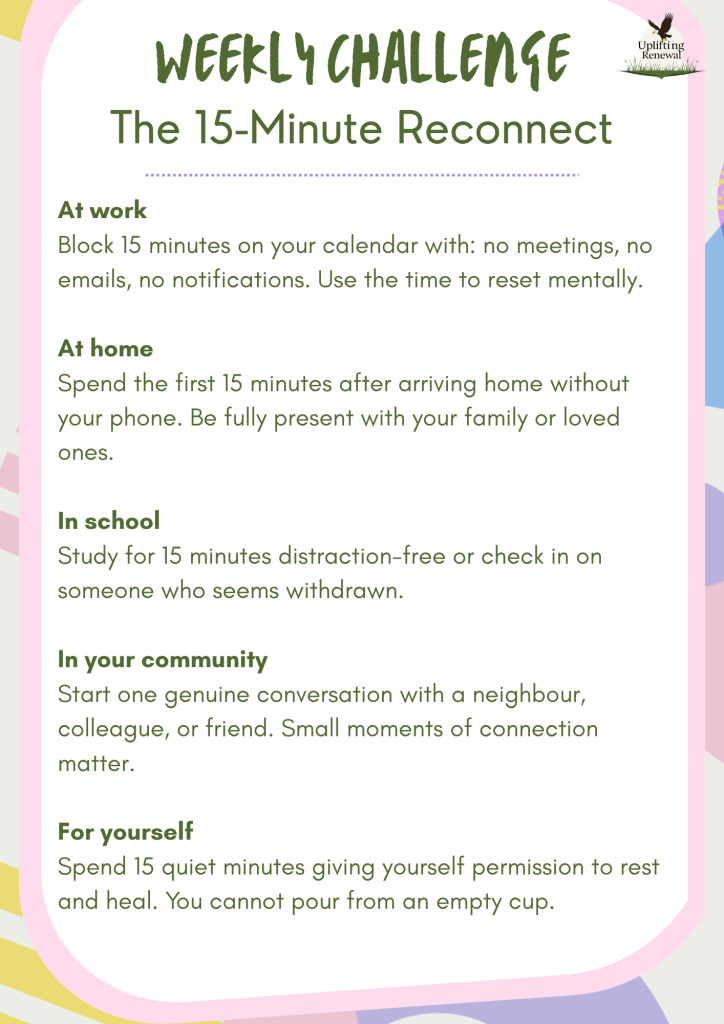
- or quality time without distractions.
Connection restores emotional strength.
In schools
Shift the focus from perfection to growth.
Not every successful life follows the same path. Young people need to know that failure is not the end of their future.
In communities
Healthy societies create spaces for belonging:
- parks,
- libraries,
- community centers,
- faith groups,
- and local support systems.
People flourish when they feel connected to something bigger than themselves.
3. Restoring hope (recovering from burnout)
When emotional exhaustion becomes chronic, people need more than motivation. They need recovery.
In the workplace
Organizations should:
- encourage real rest,
- respect time off,
- reduce after-hours communication,
- and provide accessible mental health support.
Rest should not be treated as laziness.
In relationships
Emotional boundaries matter.
Not every responsibility belongs to you.
Seeking counseling, mentorship, or support early is wisdom, not failure.
In schools and communities
Support systems should be easy to access, not difficult to navigate.
People struggling emotionally should not feel punished for reaching out.
The non-negotiable foundation: personal self-care
While systemic change matters, personal boundaries matter too.
True self-care is not selfishness.
It is stewardship.
Rest is not something you earn after destroying yourself.
Rest is what allows you to sustain your life, purpose, and relationships long-term.
Sometimes the healthiest thing you can do is:
- say no,
- slow down,
- step away,
- ask for help,
- or simply breathe.
A scriptural perspective
Scripture reminds us that emotional well-being is deeply connected to peace, perspective, and spiritual alignment.
“You will keep in perfect peace those whose minds are steadfast, because they trust in you.” — Isaiah 26:3
The Bible does not deny emotional struggle. Many biblical figures experienced fear, grief, exhaustion, disappointment, and anxiety.
What Scripture teaches is not emotional suppression, but emotional anchoring.
Philippians 4:8 reminds us to intentionally guard our thought life:
“Whatever is true, noble, right, pure, lovely, admirable—think about such things.”
Mental well-being is shaped not only by what happens around us, but also by what we continually allow into our minds.
Scripture also reminds us that we were never designed to carry life alone.
“Come to me, all you who are weary and burdened, and I will give you rest.” — Matthew 11:28
Real strength is not pretending to be unbreakable. Real strength is knowing when to rest, reconnect, and receive support.
Practical tools for daily emotional alignment
1. Protect your boundaries
Set a firm stop time for work or study.
Your brain needs moments where it is not performing, producing, or solving problems.
2. Filter the noise
Limit constant exposure to:
- stressful news cycles,
- endless scrolling,
- and comparison-driven social media.
Too much digital noise drains emotional energy.
3. Prioritise physical anchors
Mental and emotional health are connected to physical habits.
Focus on:
- quality sleep,
- movement,
- hydration,
- sunlight,
- and time outdoors.
Sometimes healing begins with basic consistency.
4. Stay connected
Isolation intensifies emotional struggle.
Reach out to:
- trusted friends,
- mentors,
- family,
- faith communities,
- or professional support systems.
Healing grows in healthy connection.
Moving forward together
Mental and emotional well-being is not just an individual issue. It is a collective responsibility.
Whether you are:
- a leader,
- a parent,
- a teacher,
- a student,
- a policymaker,
- or someone quietly trying to hold life together—
your actions matter.
Let us build environments where:
- vulnerability is respected,
- rest is normalized,
- people feel safe asking for help,
- and emotional well-being is treated as essential, not optional.
You do not have to carry everything alone.
Take life one day, one breath, and one step at a time.
“Self-care is never a selfish act, it is simply good stewardship of the only gift I have.” — Parker Palmer






 Uplifting Renewal
Leave a comment