
“I thought I was being a hero by skipping breaks. In reality, I was making poor decisions, damaging team morale, and eventually my body forced me to stop.” — Elena, Tech Lead
Have you ever reached the end of the day feeling as though you have nothing left to give?
Not just physically tired, but mentally exhausted. The kind of exhaustion where even small decisions feel overwhelming. The kind where your mind keeps racing long after your body is ready to sleep.
Many of us live in a constant state of “go.” We move from meeting to meeting, task to task, responsibility to responsibility, believing we can rest later. We promise ourselves we’ll slow down after the project is finished, after the exams are over, after the children are older, after life becomes less demanding.
But what if later never comes?
What if the key to protecting our mental and emotional well-being isn’t a two-week holiday, but small moments of restoration built into the day we already have?
The problem with waiting for a vacation
When people are overwhelmed, the standard advice is often:
“Take a break.”
“Book a holiday.”
“Get away for a few days.“
While vacations are valuable, they aren’t always realistic. Sometimes planning the break feels like another task on an already overwhelming to-do list.
The truth is that most people don’t need an escape from life as much as they need recovery within life.
A five-minute reset may seem insignificant, but when practiced consistently, those small moments can prevent the emotional and mental depletion that eventually leads to burnout.
Think of your phone. You wouldn’t expect it to function indefinitely without recharging. Yet many of us expect exactly that from ourselves.
The hidden cost of constantly pushing through
Many people wear exhaustion like a badge of honour.
“I’m busy.”
“I’m running on four hours of sleep.”
“I haven’t stopped all day.”
But constantly operating at maximum capacity comes with a cost.
- Your thinking slows down: Have you ever read the same email three times and still missed the point? Mental fatigue reduces concentration, memory, and decision-making. What feels like productivity is often just prolonged struggle.
- You lose perspective: When we’re tired, everything feels urgent. Small problems seem huge. Minor setbacks feel catastrophic. We become trapped in “tunnel vision” and lose the ability to see the bigger picture.
- Your patience disappears: The colleague’s question annoys you. The student’s behaviour frustrates you. The spilled drink sends you over the edge. Often the issue isn’t the situation itself, it’s the fact that your emotional reserves are empty.
- Eventually your body takes over: When we ignore the signals long enough, the body often forces us to stop through illness, chronic fatigue, anxiety, headaches, insomnia, or burnout. The question isn’t whether you’ll take a break. The question is whether you’ll choose it or your body will choose it for you.
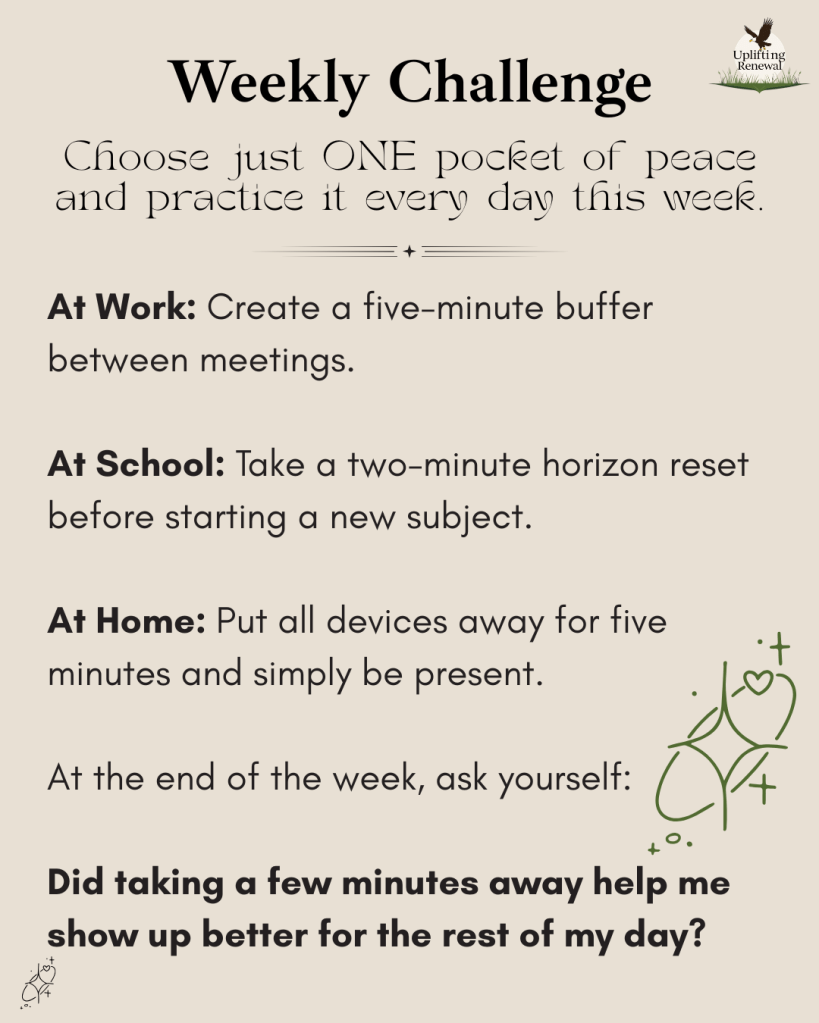
3 pockets of peace you can start today
The good news is that recovery doesn’t have to take hours. Sometimes it only takes minutes.
- Look up: Make time for your 2-minute reset. Close your laptop. Put down the paperwork. Step away from the screen. Find a window and look at the furthest point you can see for 60 seconds. Then take three slow breaths.
- This simple act helps relax the eyes, calm the nervous system, and interrupt the constant cycle of mental stimulation.
- Put the phone away: Many people think we’re resting when we scroll social media. We’re not. We are simply replacing one form of stimulation with another.
- The 3-minute digital fast. For three minutes, put your phone out of sight. Resist the urge to check notifications. Sit quietly and allow your mind to catch up with your day. You may be surprised by how refreshing three minutes of silence can feel and how difficult it is for you to reset.
- Empty your mind on paper: When everything feels urgent, your brain works overtime trying to remember everything. Instead of carrying it mentally, write it down.
- Take a 5-minute brain dump. Every task, every worry, every unfinished thought. Don’t organize it. Don’t edit it. Just unload it. What often feels overwhelming in your head becomes manageable once it’s on paper.
A word for leaders
If you’re responsible for leading others, pay attention to the pace you’re modelling.
Many teams don’t take breaks because their leaders don’t.
If managers send emails at midnight, skip lunch, and stack meetings back-to-back, employees receive an unspoken message: this is what success looks like.
But sustainable performance requires sustainable habits, so build buffer zones into calendars.
End meetings five minutes early. Take your lunch break. Encourage your team to do the same.
Permission is often modelled before it is spoken.
For students and educators
Students aren’t machines.
After long periods of concentration, learning naturally declines.
Instead of forcing another hour of attention, introduce brief resets:
- Stand up and stretch.
- Look out a window.
- Take three deep breaths.
- Have a short conversation unrelated to school.
Sometimes learning improves when we pause, not when we push harder.
For parents
Parents of young children often experience a different kind of exhaustion.
The demands are constant. Someone always needs something and wants to have conversations with you. So the house is noisy and the responsibilities never seem to end.
If this season describes your life, remember:
- You don’t need an hour
- You need a moment
- Step into another room
- Close your eyes
- Take ten slow breaths
- Splash cold water on your face
- Stand outside for two minutes
Small resets restore patience before frustration takes over. Because you cannot continually pour out what you haven’t replenished.
A scriptural perspective
The scripture never presents exhaustion as a virtue.
In fact, God Himself modelled rest.
“On the seventh day God had finished His work… and He rested.” — Genesis 2:2
Jesus also understood the importance of withdrawing from constant demands.
“He often withdrew to lonely places and prayed.” — Luke 5:16
Notice that Jesus didn’t wait until everything was finished before resting. He stepped away regularly. He created pockets of peace.
When life becomes overwhelming, the Word of God invites us to do the same.
“Be still, and know that I am God.” — Psalm 46:10
Stillness isn’t laziness, it is trust. It is also recognition that the world does not rest on your shoulders. And perhaps one of the most practical invitations in the Bible is found in:
“Cast all your anxiety on Him because He cares for you.” — 1 Peter 5:7
Many of us carry burdens we were never designed to carry alone. God’s invitation is simple: Put them down.
“I thought I was being a hero by skipping breaks. In reality, I was making poor decisions, damaging team morale, and eventually my body forced me to stop.” — Elena, Tech Lead
You do not need to earn rest. You need rest to keep going. Waiting for the next holiday, the next long weekend, or the next season of life to slow down is not a sustainable strategy.
Instead, build small pockets of peace into the day you already have. Two minutes. Three minutes. Five minutes.
Small pauses create big change. Because mental and emotional well-being is not built in grand gestures. It is built in daily rhythms.
One breath. One pause. One moment of peace at a time.
“I remember sitting in my car after a 12-hour day, staring at the steering wheel, and realizing I didn’t even have the energy to turn the key. I was completely hollow.” — Sarah, Senior Project Manager





 Uplifting Renewal
Leave a comment