

“It doesn’t make sense to hire smart people and tell them what to do; we hire smart people so they can tell us what to do.”
— Steve Jobs
The workplace reality nobody talks about
Most of us spend a significant portion of our lives at work. Yet work is rarely just about the work.
It’s about personalities, politics, competing priorities, unspoken rules, performance pressures, and navigating relationships with people we didn’t choose but must somehow collaborate with every day.
Some workplaces bring out the best in people. Others slowly drain confidence, motivation, and emotional energy.
The uncomfortable truth is that career success isn’t determined by hard work alone. Competence matters. Character matters. Results matter. But your ability to navigate the environment around you matters just as much.
A brilliant employee can struggle in a toxic culture, while an average performer in a healthy environment can thrive.
The goal isn’t simply to survive the workplace. The goal is to succeed without losing yourself in the process.
The foundation: Four principles for long-term success
1. Focus on strategy, not frustration
Every workplace has flaws. Some have bureaucracy, others have politics. Some have poor leadership, others have hidden biases.
You may not be able to change the system overnight, but you can learn how to navigate it wisely.
Instead of spending all your energy fighting every obstacle, focus on positioning yourself for success despite the obstacles.
Ask:
- Where are the opportunities?
- Who are the key stakeholders?
- What skills will make me indispensable?
- What battles are worth fighting?
Strategy often achieves what frustration never will.
2. Be your own advocate
Many talented professionals quietly sabotage themselves. They assume good work will automatically be noticed.
Sometimes it is, often it isn’t.
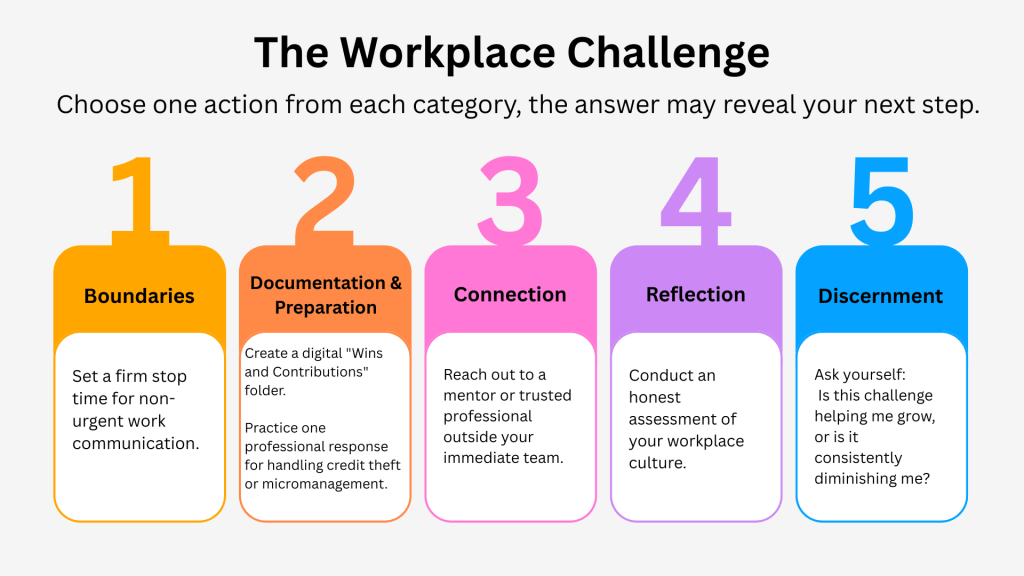
Advocating for yourself isn’t arrogance, it’s responsibility. So, track your achievements, speak confidently about your contributions, volunteer for visible projects and build relationships beyond your immediate team.
Don’t wait for others to tell your story for you.
3. Competence is only the starting point
Most organisations are filled with competent people.
What often separates those who progress from those who stagnate is a combination of:
- Competence
- Wisdom
- Emotional intelligence
- Discretion
- Trustworthiness
Technical skill may get you in the room but character determines how long you stay there.
4. Learn the rules of the game
Before you can navigate an organisation effectively, you must understand how it operates.
Read the policies, understand reporting procedures and know the code of conduct.
Learn the informal culture.
- Who influences decisions?
- How are promotions made?
- How are conflicts handled?
Knowledge creates protection, while ignorance creates vulnerability.
Spotting the red flags early
Toxic cultures rarely appear overnight. They develop gradually until unhealthy behaviour becomes normal.
The earlier you recognise the warning signs, the better positioned you are to protect yourself.
Communication breakdowns
Pay attention when:
- Information is deliberately withheld.
- Passive-aggressive emails become normal.
- Nobody receives constructive feedback.
- Teams operate in silos.
Healthy organisations communicate clearly. Unhealthy organisations communicate strategically.
The trust gap
When leadership lacks transparency, people fill the gaps with assumptions.
This often creates an “us versus them” culture where employees feel disconnected from decision-makers.
Trust is difficult to build and easy to lose.
Cultural decay
Warning signs include:
- High staff turnover
- Constant gossip
- Micromanagement
- Blame-shifting
- Workplace bullying
- Favouritism
- Lack of recognition
- Limited growth opportunities
One sign alone may not indicate a toxic culture, but several together should get your attention.
The “always-on” culture
Technology has blurred the line between work and personal life.
When employees feel pressure to respond to messages at all hours, burnout becomes inevitable.
A workplace that consistently ignores boundaries will eventually exhaust its people.
Protecting yourself without losing your peace
One of the biggest mistakes professionals make is assuming that being right is enough.
It isn’t.
You must also be wise.
Choose your battles carefully
Not every disagreement requires a confrontation. Not every injustice requires your personal intervention.
Ask yourself:
- Do I have the influence to change this?
- Do I have the evidence?
- Do I have the emotional capacity to engage?
While sometimes the wisest move is addressing an issue. Other times the wisest move is conserving your energy.
Discernment matters.
Protect your inner balance
Workplace challenges become far more difficult when you are emotionally depleted. Protect your mental and emotional reserves.
Get enough rest, exercise regularly and maintain relationships outside work.
Develop interests that remind you that your identity is bigger than your job title.
The stronger you are internally, the harder it becomes for toxic environments to define you.
“People don’t leave bad jobs; they leave bad bosses and toxic cultures.” — Dr. Travis Bradberry
Different roles, different challenges
Interns and new hires
When you’re new, your first responsibility isn’t changing the culture, it’s understanding it.
Observe.
Listen.
Learn.
Find a mentor who understands both the written rules and the unwritten ones.
The right mentor can save you years of unnecessary mistakes.
Managers
Managers often experience pressure from both directions. Senior leaders want results and team members need support.
The best managers act as buffers.
They protect their teams from unnecessary chaos while helping the organisation achieve its goals.
People perform better when they feel protected, respected, and supported.
Executives
The higher you climb, the easier it becomes to lose touch with reality.
People filter information. Bad news travels slowly. Honest feedback becomes rare. This creates the “executive echo chamber.”
If you’re in leadership, actively seek uncomfortable truths before culture problems become crises
The workplace peacemakers
Every office has one. The person everyone confides in, who mediates conflicts and keeps the team together.
If that’s you, be careful.
You cannot carry everyone’s emotional burdens. Support people without becoming their emotional dumping ground.
Handling common workplace challenges
“Micromanagement is the ultimate short-term thinking. It produces immediate results at the cost of long-term soul-crushing turnover.” — Seth Godin
Managing a micromanager
Micromanagement is often rooted in anxiety, fear, or a lack of trust. While frustrating, reacting emotionally rarely helps.
Instead, proactively provide updates before they’re requested. Share progress regularly to reduce uncertainty.
Over time, this often builds trust and creates more autonomy.
When addressing the issue directly, focus on productivity rather than frustration.
Try:
“I work best when I have some room to execute independently. Could we agree on specific checkpoints so you’re informed without needing constant updates?”
Handling credit theft
Few workplace experiences are more frustrating than watching someone else receive recognition for your work.
When it happens, avoid public confrontation. Instead, calmly re-establish your contribution.
For example:
“I’m glad that idea is gaining traction. When I developed the initial framework, I focused specifically on solving X challenge. The next phase we discussed was…”
You don’t need to attack anyone.
You simply need to reconnect yourself to the work. Professionalism often speaks louder than outrage.
Your secret weapon: Documentation
When workplace issues arise, memory is not enough, documentation is.
Create a professional record of:
- Major achievements
- Positive feedback
- Project contributions
- Significant incidents
- Important conversations
Make sure you save emails, keep dates, record facts. Not emotions, facts carry weight.
If you ever need to approach HR or leadership, a clear paper trail becomes invaluable.
Don’t neglect your well-being
A toxic workplace doesn’t stay at work. It follows people home. It affects sleep, relationships, confidence and physical health.
Pay attention to what your body is telling you. If work stress is becoming chronic, don’t ignore it.
Invest in your well-being before burnout forces the decision for you.
Build a support system beyond work
One of the biggest mistakes professionals make is allowing their workplace to become their entire world.
Build relationships outside your organisation, connect with mentors. Speak with trusted friends and network with people in your industry.
External perspectives provide clarity when workplace challenges start distorting your thinking.
Knowing when it’s time to leave
Not every workplace can be fixed.
If you’ve documented concerns, raised issues appropriately, sought support, and nothing changes, it may be time to move on.
Leaving is not failure, sometimes it is wisdom.
If your health, peace of mind, values, or growth are being consistently sacrificed, start preparing your next move.
Update your CV, strengthen your network and apply strategically for roles that align with your goals. And during interviews, remember this: You are interviewing the company too.
A scriptural perspective: Wisdom in the workplace
Faith doesn’t remove workplace challenges, it provides guidance for navigating them.
- Integrity: Your standards should not depend on your environment. Even when others cut corners, choose excellence.
“Whatever you do, work at it with all your heart, as working for the Lord.” — Colossians 3:23
- Conflict: Not every battle requires aggression. Calm responses often achieve more than emotional reactions.
“A gentle answer turns away wrath, but a harsh word stirs up anger.” — Proverbs 15:1
- Discernment: Nehemiah faced opposition, criticism, and sabotage while rebuilding Jerusalem’s walls. Yet he knew when to ignore distractions, when to confront problems, and when to keep building. Workplace wisdom often requires the same balance. Not every obstacle is meant to stop you, some are simply meant to teach you strategy.
“Success is not final, failure is not fatal: it is the courage to continue that counts.” — Winston Churchill
You cannot control every workplace, every manager and every decision. But you can control how you respond.
So build your competence, protect your peace, document your value, strengthen your boundaries and develop wisdom.
And remember: A healthy career is not just about professional success.
It’s about becoming successful without losing your integrity, your confidence, or yourself along the way.





 Uplifting Renewal
Leave a comment