
“The only source of knowledge is experience.” — Albert Einstein
Six months ago, many of us started 2026 with ambitious goals, fresh motivation, and carefully written plans.
Now we’re halfway through the year.
Some goals are thriving. Others have quietly stalled. And some no longer reflect the life you’re living today.
That’s completely normal.
A mid-year review isn’t about judging yourself or feeling guilty about what didn’t happen. It’s about pausing long enough to learn from the first half of the year so you can make the second half more intentional.
Whether you’re a corporate professional, entrepreneur, student, stay-at-home parent, retiree, spiritual leader, or navigating a season of change, this is your opportunity to reset your direction.
Remember: a lack of progress isn’t failure, it’s feedback. It tells you that something about your goal, timeline, habits, or strategy needs adjusting.
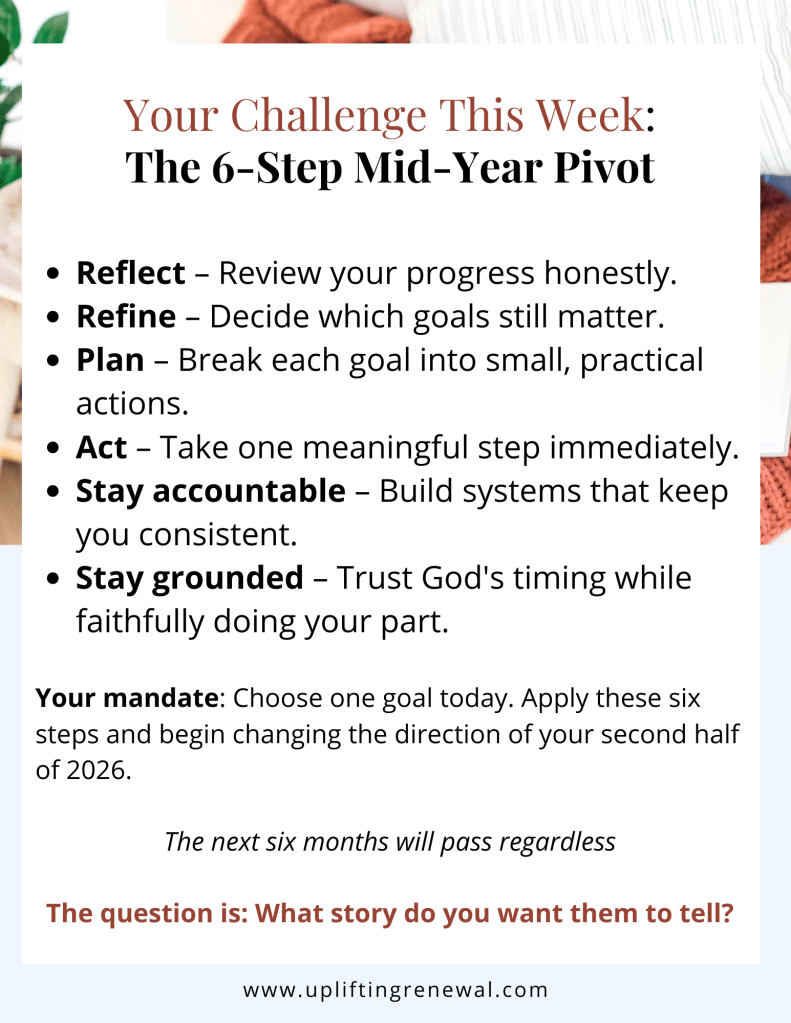
1. Review your progress honestly
Before making new plans, understand where you stand today.
Don’t rely on feelings, look at the facts.
Ask yourself:
- What progress have I actually made?
- Which goals have moved forward?
- Which ones have stalled?
- Which habits helped me?
- Which habits held me back?
Evaluate every major area of your life:
- Career or business
- Finances
- Health
- Relationships
- Personal development
- Spiritual growth
Celebrate every win
Don’t overlook small victories because they weren’t your original destination. Maybe you didn’t reach your income target, but you paid off debt.
Maybe you didn’t lose all the weight you hoped to, but you’re exercising consistently.
Progress deserves recognition.
“The more you praise and celebrate your life, the more there is in life to celebrate.” — Oprah Winfrey
Learn from what didn’t work
Every setback contains valuable information.
Instead of asking, “Why did I fail?”, ask:
- What got in the way?
- What would I do differently?
- What have I learned about myself?
The goal isn’t perfection, it’s improvement.
2. Recalibrate your goals
Not every goal deserves to stay on your list. As your life changes, your priorities should too. Sort every goal into one of three categories.
Keep
- These goals still matter deeply.
- Instead of making them bigger, make them simpler.
- Break them into small daily or weekly actions that are easy to maintain.
Adjust
- Some goals are still worthwhile but unrealistic within the remaining six months.
- Scale them back or move them into next year’s plans.
For example: Instead of reading 12 books this year, commit to reading four well.
Progress is better than abandoning the goal altogether.
Release
- Some goals simply no longer fit.
- Perhaps your circumstances changed.
- Perhaps your priorities shifted.
- Perhaps you’ve grown.
Let those goals go without guilt.
Protecting your time and energy for what matters most is wisdom, not failure.
“A man is rich in proportion to the number of things which he can afford to let alone.” — Henry David Thoreau
3. Reset your direction
Once you’ve decided what stays and what goes, create a fresh plan.
Simplify: Remove unnecessary commitments and focus on fewer priorities done exceptionally well.
Replace: Archive low-value goals and replace them with objectives that reflect your current season of life.
Refine: Rewrite your remaining goals so they’re,
- Specific
- Measurable
- Achievable
- Relevant
- Time-bound
Think in 90-day sprints
Rather than worrying about December, focus on July through September.
Ninety days feels manageable and smaller deadlines create momentum.
4. Identify what’s blocking your progress
Goals rarely fail because of a lack of ambition. More often, they fail because of hidden obstacles.
Ask yourself:
- Am I trying to do too much?
- Am I constantly distracted?
- Do I struggle with decision fatigue?
- Is my schedule supporting my priorities?
- Am I spending time on things that don’t really matter?
Where possible:
- Eliminate unnecessary tasks.
- Automate repetitive work.
- Delegate what someone else can do.
- Protect focused work time.
- Stop multitasking.
Sometimes the biggest obstacle isn’t you.
Economic pressures, family responsibilities, health challenges, or unexpected life events may have changed your circumstances.
You can’t always control your environment. You can only control your response. So adapt your strategy instead of abandoning your purpose.
Releasing an outdated goal isn’t quitting, it’s evidence that you’ve grown.
5. Focus on what matters most for the second half of the year
Don’t try to transform every area of your life at once. Choose two or three high-impact priorities.
These might include:
Career & business
- Learn a valuable new skill.
- Complete a major project.
- Earn a certification.
- Grow your business.
Finances
- Build savings.
- Invest consistently.
- Reduce debt.
- Improve budgeting.
Health
- Exercise regularly.
- Improve your nutrition.
- Sleep better.
- Reduce stress.
Personal growth
- Read more
- Develop a new hobby
- Volunteer
- Travel
- Build stronger habits
Relationships: Invest intentionally in your family, friendships, and community.
Spiritual growth:
- Spend consistent time in Scripture and prayer
- Grow in character
- Remain connected to your faith community
Life transitions: Whether you’re buying a home, changing careers, becoming a parent, or entering retirement, begin with what you have today.
Small beginnings still lead somewhere.
No goals yet?
If you never created goals back in January, don’t let that stop you. You still have six months.
Today is a perfectly good day to begin.
“You don’t have to see the whole staircase, just take the first step.” — Dr. Martin Luther King Jr.
6. Build your execution system
Goals without systems rarely become reality. Translate every remaining goal into practical daily actions.
As Henry Ford wisely said:
“Nothing is particularly hard if you divide it into smaller jobs.”
Break every objective into bite-sized tasks. Then create a way to track your progress.
Use whatever works for you:
- a planner
- a journal
- a whiteboard
- a spreadsheet
- a digital app
The tool doesn’t matter nearly as much as using it consistently.
Outline what you want to accomplish during Q3 and Q4. Map out July before it begins.
Carry unfinished priorities forward intentionally instead of letting them disappear.
If you’re a visual planner, use colours to organise different goal categories.
Most importantly, focus on one important thing at a time. Consistency, not intensity, is what produces lasting results.
“You do not rise to the level of your goals. You fall to the level of your systems.” — James Clear
A scriptural perspective
Scripture consistently teaches the importance of reflection, planning, diligence, and seeking God’s direction.
Plan diligently
“The plans of the diligent lead surely to abundance.” — Proverbs 21:5
Hard work is important, but wise planning gives your effort direction.
Evaluate regularly
In Genesis 1, God reviewed each stage of creation before moving to the next. Reflection was part of the process.
Regular evaluation helps us recognise what is working and what needs adjusting.
Assess reality honestly
Before creating Eve, God observed Adam’s situation and declared, “It is not good for the man to be alone” (Genesis 2:18).
God’s response demonstrates the importance of honestly assessing our current reality before determining the next step. Effective change begins with an accurate understanding of what is needed.
Count the cost
Jesus taught that wise builders first calculate what is required before beginning (Luke 14:28–30).
Planning prevents unnecessary frustration later.
Prepare for future seasons
Proverbs 6:6–8 points to the ant as an example of wisdom. Working faithfully today while preparing for tomorrow.
Review and encourage consistently
Throughout Paul’s letters, we see a pattern of regular follow-up, encouragement, correction, and accountability.
Growth is rarely accidental, it is cultivated through consistent review and intentional action.
Finally, don’t mistake faith or hope for passivity. Trusting God does not remove our responsibility to act. Scripture reminds us that “faith without works is dead” (James 2:17). Pray, believe, plan, and then faithfully do the work that is within your hands.
Your mid-year checklist
By the end of this review you should:
- Know what worked during the first half of the year.
- Understand what needs to change.
- Have a simplified list of meaningful goals.
- Have a clear plan for Q3 and Q4.
- Know exactly what you’re doing in July.
Repeat this review every quarter. Small course corrections prevent major detours.
Whether you’re celebrating incredible progress, recovering from disappointment, or starting from scratch, take one decisive step today.
Don’t wait until everything feels perfect. Action creates momentum.
As Proverbs 16:9 reminds us:
“In their hearts humans plan their course, but the Lord establishes their steps.”
Plan diligently, work faithfully and remain flexible.
Trust God’s leading, even when the journey unfolds differently than you expected.





 Uplifting Renewal
Leave a comment