
“You are the average of the five people you spend the most time with.” — Jim Rohn
Take a moment and ask yourself:
Are the people around me stretching me or shrinking me?
Your inner circle is an invisible thermostat. It quietly sets the temperature for your ambition, your risk tolerance, and your definition of success. If the temperature is low, you will unconsciously adjust to it. If it’s high, you will rise to meet it.
Growth is not only about learning new skills. It’s also about designing the environment that makes growth inevitable.
Why the “five people rule” is not a cliché
Your career is rarely a solo journey. It is shaped by the gravity of the people around you.
Mindset osmosis
You adopt the language, attitudes, and habits of those closest to you. If they see problems as dead ends, you will too. If they see them as data and opportunity, you’ll begin to think that way.
Information advantage
Your network is often your first source of unadvertised opportunities, industry shifts, and internal insight that never reaches job boards.
Constructive friction
A high-performing circle won’t let you play small. They challenge your thinking, sharpen your ideas, and raise your standards.
“As we grow up, we realise it becomes less important to have a ton of friends, and more important to have real ones.” – Mindy Kaling
What happens when you’re in the wrong circle
Failing to audit your circle is often a silent career killer.
The association trap
In professional spaces, you are often judged by the company you keep. If you are frequently seen with people known for gossip, negativity, or low performance, leadership may subconsciously attach those traits to you.
Opportunity blindness
A stagnant circle creates an echo chamber. If everyone around you has the same level of experience and thinking, you lose access to new ideas, referrals, and hidden opportunities.
Skill stagnation
If no one around you is ahead of you, you stop stretching. Your value plateaus.
Emotional exhaustion
Negativity is contagious. Constant exposure to complaint-driven conversations drains the mental energy you need to innovate and excel.
“It’s better to be alone than in bad company.” – George Washington
How to audit your professional circle
This is not about cutting people off. It’s about reallocating your time toward people who help you grow.
1. The reputation check (Your social brand)
Who are you most often seen with at work or online? Are they known for integrity and excellence, or for complaints and drama?
Goal: Be associated with people respected for their work ethic and professionalism.
2. The growth check
Do the people around you have skills you don’t have?
If you are the most experienced person in your circle, you have hit a growth ceiling.
Goal: Add “stretch” connections, people one or two steps ahead of you.
3. The advocacy check
Do you have anyone in your circle who speaks your name in rooms you’re not in?
Peers are important, but progress often requires sponsors; people with influence.
Goal: Build upward connections, not just horizontal ones.
4. The energy check (Builders vs. Drainers)
Categorise your circle:
- Drainers — complain without action, spread pessimism
- Builders — solution-oriented, forward-thinking
- Sustainers (steady, reliable)
- Propellers (challenging, inspiring, ahead of you)
Goal: Limit time with Drainers. Invest in Builders.
5. The diversity check
If everyone in your circle works in the same department or thinks the same way, you have blind spots.
Goal: Build relationships across functions and backgrounds.
“Pay attention to who is happy when you are happy.” – Pema Chödrön
Your personal inner circle
Curating your environment isn’t elitist; it’s a necessary protection of your energy and trajectory. Growth is impossible in a stagnant room. If you are the smartest person there, you are in the wrong place.
Your circle should act as a thermostat, actively setting the tone for your life rather than merely reflecting it.
This doesn’t mean you must “fire” every friend who isn’t a top-tier mentor. It means you re-categorise people. Some belong in your inner sanctum. Others fit better in the acquaintance or recreational lanes.
A smaller, intentional circle builds a stronger foundation for where you’re going.
Your personal audit checklist
When looking at your personal circle, ask:
Reciprocity: Does the energy flow both ways, or am I a constant charging station for them?
Celebration: Can they genuinely celebrate my wins without sarcasm or competition?
Alignment: Do their habits reflect the life I’m trying to build?
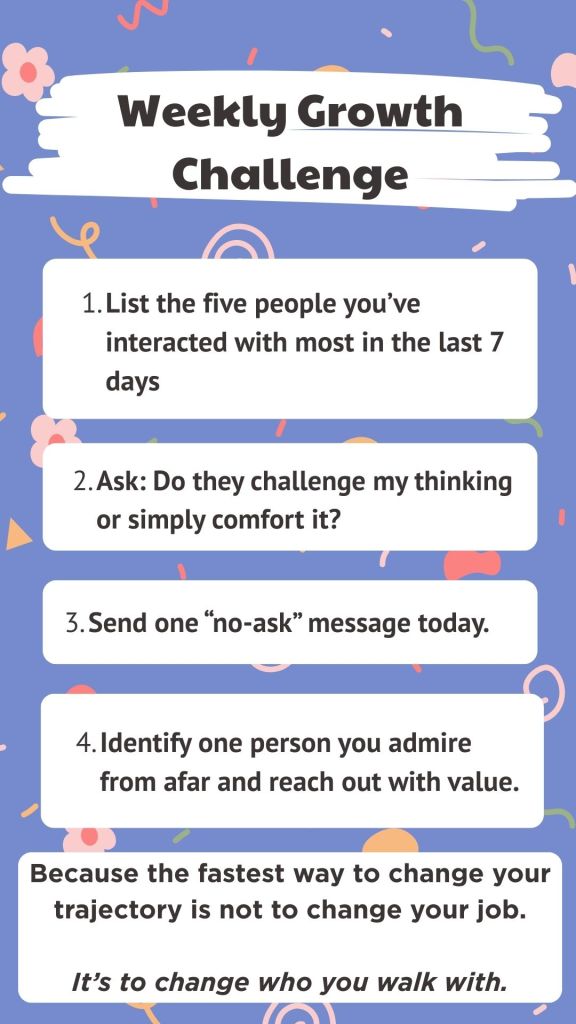
The “no-ask” message: A powerful tool for upgrading your circle
Once you audit your circle, you may realise there’s a gap between where you are and where you want to be. To bridge that gap, you need to connect with Propellers.
A no-ask message is a short message sent to provide value, appreciation, or insight, without requesting anything.
It works because:
- It lowers the barrier for busy, high-value people to engage with you
- It positions you as a contributor, not a consumer
- It builds social capital without pressure
The simple formula
The hook: Why you’re reaching out
The value: What impact it had on you
The exit: “No need to reply”
Example:
“I read your recent article on systems thinking and it changed how I’m approaching a project this week. Just wanted to share my appreciation, no need to reply!”
Over time, these small touches warm up distant connections and help you move into stronger circles naturally.
Scriptural perspective
Scripture reminds us that relationships are never neutral, they shape our direction.
- Wisdom through association — “Walk with the wise and become wise.” (Proverbs 13:20)
- Character protection — “Bad company corrupts good character.” (1 Corinthians 15:33)
- Mutual sharpening — “As iron sharpens iron, so one person sharpens another.” (Proverbs 27:17)
- Strength in partnership — Ecclesiastes 4:9
The Bible encourages intentional companionship because who you walk with determines where you end up.
Design an environment where success is natural
Success is not only about working harder. It’s about placing yourself in an environment where growth is the default.
Your circle should feel less like random contacts and more like a personal board of advisors for your life and career.
Small shifts in proximity create massive shifts in perspective.







 Uplifting Renewal
Leave a reply to Rosemary Edu-Obanya Cancel reply