
We are almost at the end of the first quarter of the year.
While most people are adding more to their list of to do, this post is exploring why doing less may be the smartest move you make this year to achieve your goals.
“The difference between successful people and really successful people is that really successful people say no to almost everything.” — Warren Buffett
We live in a world that celebrates more. More goals, more productivity, more output. But what if real growth isn’t found in adding, but in subtracting?
As the year unfolds, many of us feel buried under growing to-do lists. Yet true progress isn’t about doing everything, it’s about doing the right things.
And that starts with a powerful shift:
Not everything deserves your time, energy, or attention.
Why you need a “not-to-do” list
A “not-to-do” list isn’t about restriction, it’s about protection.
It protects:
- Your time
- Your focus
- Your energy
- Your purpose
It helps you move from reacting to life to leading it intentionally.
Because clarity doesn’t come from doing more.
It comes from deciding what you will no longer tolerate.
Sometimes the fastest way to discover what matters is to eliminate what doesn’t.
“Focus is a matter of deciding what things you’re not going to do.” — John Carmack
Your starter “not-to-do” list
If you’re not sure where to begin, start here. These boundaries deliver immediate impact:
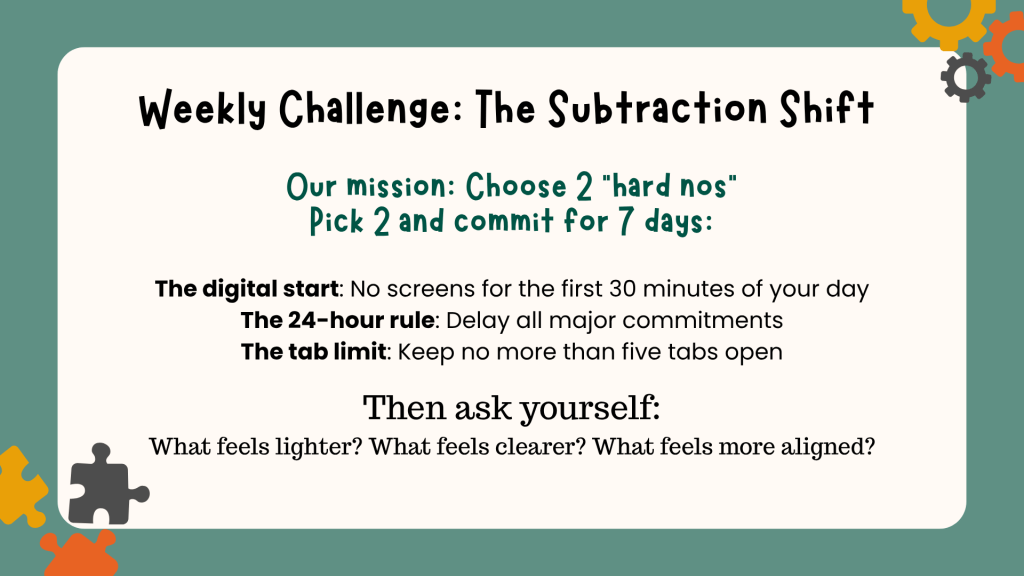
1. The immediate “yes” trap: Do not commit on the spot. It’s good practice to use a 24-hour rule for decisions. Instead of reacting, respond with: “Let me check my priorities and get back to you.” This protects you from overcommitment and regret.
2. Digital drift: Do not start your day with other people’s priorities. When you start work, avoid emails or responding to colleagues in your first 30 minutes. Also, learn to protect your closing hours, no last-minute work requests. This means you should own your morning and protect your evening.
3. The meeting drain: Do not always accept meetings without a clear purpose. If there’s no agenda, there’s no direction. And if there’s no direction, there’s no value.
4. The perfectionist’s stall: Do not edit while you create. This means you should focus on progress first. Perfection can come later. So separate the builder (who creates) from the editor (who refines).
5. Desktop dining: There’s a reason work places have an hour designated for lunch break. It’s important to not eat at your desk. Step away to reset your mind. A short, intentional break increases focus more than constant hustle ever will.
“It is not a daily increase, but a daily decrease. Hack away at the unessential.” — Bruce Lee
Build boundaries that match your season
Your “not-to-do” list should reflect where you need growth most.
- If you need focus for deep work
- Do not check notifications in your first 90 minutes
- Do not use “ASAP” it creates false urgency
- Do not keep more than five tabs open
- Focus grows where distractions are removed.
- If you need peace for emotional health
- Do not over-explain your “No”
- Do not apologise for having boundaries
- Do not carry your phone into rest spaces (especially before sleep)
- Peace is protected, not accidental.
- If you need creativity for momentum
- Do not start new projects before finishing current ones
- Do not compare your work mid-creation
- Do not focus on aesthetics before substance
- Clarity comes through completion, not constant starting.
The real ROI: what happens when you say “no”
When you honour your boundaries:
- Your “yes” becomes more valuable
- Your focus sharpens
- Your energy lasts longer
- Your decisions improve
You stop reacting to life and start directing it.
The cost of ignoring this
Without boundaries, life becomes crowded with noise.
- Your mornings are hijacked
- Your energy is drained
- Your priorities get buried
- Your progress slows
You end up living according to everyone else’s agenda but your own.
“No is a complete sentence.” — Anne Lamott
A spiritual perspective
Spiritually, wisdom is often defined not just by what we do but by what we refuse to do.
The Bible teaches that a meaningful life is shaped by discernment and boundaries. Not everything is harmful but not everything is helpful.
““I have the right to do anything,” you say—but not everything is beneficial. “I have the right to do anything”—but not everything is constructive.” — 1 Corinthians 10:23
Some things are not sins they are simply weights. Growth requires letting go.
“Let us throw off everything that hinders…” — Hebrews 12:1
The power of subtractions
- The discipline of “not doing”: Even rest is a divine “not-to-do” command. Exodus 20:10 mandates rest for everyone. In a culture obsessed with doing, God invites us into intentional stillness.
- Guarding your inner world: Boundaries are not just external, they should also be internal. Sometimes discipline looks like restraint and growth looks like silence.
- The bottom line: A “not-to-do” list is not about limitation but about alignment. Every “no” creates space for a better “yes.” So instead of asking: “what more should I do?”, ask: “what am I finally ready to let go of?”
Sometimes the breakthrough you’re waiting for isn’t in doing more. It’s in finally deciding what you’re no longer going to do.





 Uplifting Renewal
Leave a comment