
“The future belongs to those who learn more skills and combine them in creative ways.” – Robert Greene.
For decades, we were told the same career story: pick one thing, specialise deeply, and success will follow.
That advice worked in stable systems, but we no longer live in a stable world.
In today’s volatile, fast-changing economy, narrow specialisation is no longer safety, it’s exposure. Roles evolve. Industries shift. Automation replaces tasks. And professionals who can only do one thing often struggle to pivot when change arrives.
The new form of career security is not depth alone. It is skill-stacking.
What is skill-stacking?
Skill-stacking is the intentional combination of multiple complementary skills. These skills can be technical, strategic, and human. This combination creates a unique professional profile that is difficult to replace.
Instead of becoming world-class at one thing, you build a system of skills that work together.
Think:
- Technical expertise + communication
- Strategy + emotional intelligence
- Data + storytelling
- Systems thinking + leadership
This approach transforms you from a replaceable role-filler into an indispensable problem-solver.
You stop competing on job titles and start competing on value.
“Every skill you acquire doubles your odds of success.” – Scott Adams.
How to move from specialist to strategist
In the modern economy, authority no longer sits at the top of a single ladder. It lives at the intersection of skills.
- The power of intersection: Innovation happens when the logic of one field solves the problems of another. A marketer who understands systems thinking doesn’t just run campaigns, they eliminate inefficiencies. A project manager with conflict resolution skills doesn’t just deliver timelines, they stabilise teams. A technical expert who can communicate clearly gets heard by decision-makers. When skills intersect, insight multiplies.
- The law of diminishing returns: Reaching the top 1% in one field often takes decades of obsession. But reaching the top 20% in three complementary skills is achievable and far more powerful. Being good at analysis, strong at communication, solid in strategy…creates a professional “moat” that is nearly impossible to replicate.
- Growth is architecture, not accident: Most careers grow randomly; books here, webinars there, skills without direction. Skill-stacking requires intentional design. Instead of asking, “What should I learn next?” Ask, “What skill will multiply the value of what I already know?”
If your core skill is technical, your next move shouldn’t always be more technical training. It could be a force multiplier, such as a skill that helps your expertise travel further.
Practical framework to build your skill-stack
Step 1 – Define your anchor: Your anchor is your core professional skill, the one that currently defines your role.
Examples:
- Project management
- Legal expertise
- Data analysis
- Teaching
- Software development
- Engineering
Step 2 – Add a force multiplier: This is the skill that scales your impact.
Examples:
- Systems thinking (prevents constant firefighting)
- Strategic writing (influences decisions)
- Negotiation (protects value)
- Data storytelling (turns insight into action)
While your anchor gives you weight, the multiplier gives you momentum.
Step 3 – Integrate the human layer: This is where influence happens.
Examples:
- Communication
- Conflict resolution
- Emotional intelligence
- Leadership presence
Great ideas fail without human buy-in. This layer ensures your work doesn’t just exist, it moves people.
“Interdisciplinary communication is where truly great ideas emerge.” – Carl Segar
Why skill-stacking works
1. The “niche of one”: When you combine uncommon skills, you stop competing on experience and start competing on uniqueness. You become the only person who solves a specific problem in a specific way.
2. Career anti-fragility: Skill-stacking acts as career insurance. If one industry slows down, your stack allows you to pivot sideways, not start over.
3. Higher value, higher leverage: Employers and clients value professionals who reduce complexity. One person who can think, execute, and communicate is worth more than three siloed roles.
4. Better problem-solving: A broader skill set gives you multiple lenses. You don’t just see problems, you see connections others miss.
5. Protection against automation: Automation can replace tasks but it struggles to replace integration, judgment, empathy, and strategy.
Skill-stacking keeps you human in a digital world.
“Realise that everything connects to everything else.” — Leonardo da Vinci
Scriptural perspective: Stewardship, not self-promotion
Skill-stacking aligns with the biblical principle of stewardship.
Scripture teaches that abilities are investments entrusted to us that are meant to be developed, multiplied, and used wisely.
“If the axe is dull… more strength is needed, but skill brings success.” — Ecclesiastes 10:10
God honours growth, excellence, and refinement, not stagnation.
Redefine your trajectory
True impact doesn’t come from mastering one narrow lane. It comes from who you are becoming at the intersection of your gifts.
In 2026 and beyond, the competitive advantage is not being the best in a crowded field. It is being the only one with your specific combination of skills.
For those in a fixed structure like the public sector, this moment of redefinition can feel especially disorienting. When your identity, routine, and sense of purpose have been shaped by rank, structure, and service, a sudden transition can be challenging. Whether through retirement, restructuring, or unexpected change, it can leave you feeling untethered.
The right approach is to intentionally skill-stack to help you translate your experience, discipline, leadership, and institutional wisdom into the next phase of impact.
Don’t just climb the ladder everyone else is on.
Design your own architecture.
Next week’s challenge: The 15-minute skill audit
Stop competing on merit, rather start winning on uniqueness.
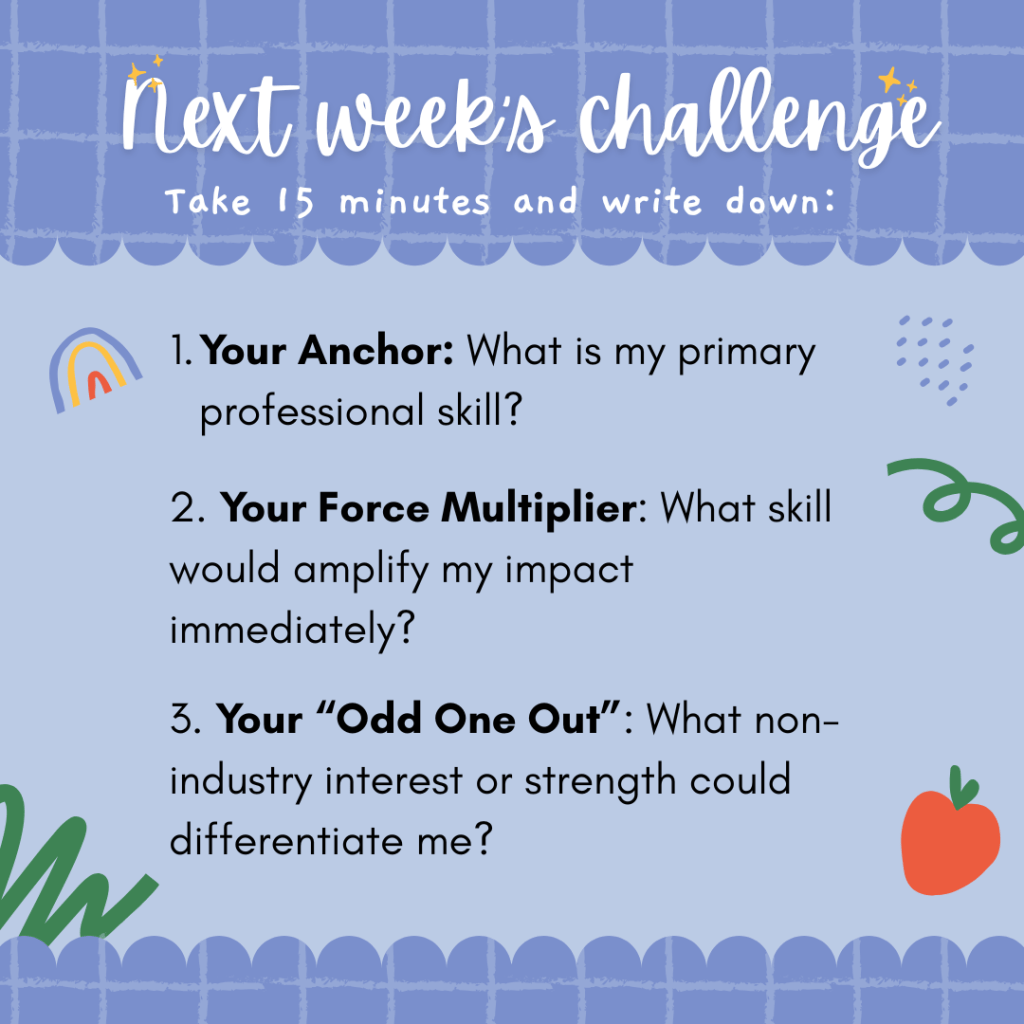
Create your stack statement:
I leverage [Anchor] and [Force Multiplier] to help [Audience] achieve [Result] through the unique lens of [Odd One Out].
This is how you move from a standard hire to an indispensable asset.
Growth isn’t about doing more, it’s about building smarter. And your future belongs to the architecture you choose today.





 Uplifting Renewal
Leave a comment